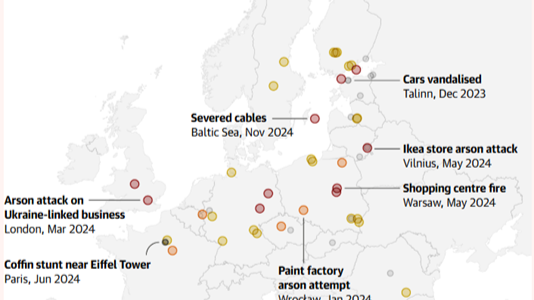
On 12 May 2024, a fire broke out at a large shopping center in Warsaw, Poland, burning down 1,400 shops, many of which were run by the city’s Vietnamese community. One year later, after an extensive and multi-agency investigation, Poland’s Prime Minister Donald Tusk took to X to announce that ‘we now know for certain that the massive fire on Marywilska was the result of arson commissioned by Russian services.’
The arson, according to officials involved in the investigation, was part of a large, coordinated sabotage campaign directed from Russia. Evidence suggests that Moscow recruited agents in Poland via the messaging app Telegram and paid them to start the fire. In response, Polish Foreign Minister Radostaw Sikorski said the country would close the Russian consulate in Krakow.
While Moscow called these allegations ‘baseless’ and has consistently denied any involvement in a slew of arson and sabotage operations across Europe, it is now believed that this attack is part of a larger campaign launched by Russia’s intelligence services on the west which, while violent, is carried out piecemeal, making it hard to prove. And while sometimes the targets of these attacks are clearly focused on supporters of the Ukrainian war efforts, more often the objective is simply to cause chaos and disruption and elicit fear and anxiety.
Between 2023 and 2024 a number of seemingly disconnected and largely petty criminal attacks were carried out throughout Europe, targeting transportation, government, critical infrastructure and industry. However, when taken together, these incidents point to the involvement of Russia’s intelligence services.
Evidence derived from thousands of pages of court documents, interviews with current and former security and intelligence officials and discussions with people who knew the perpetrators shed light on a state-sponsored syndicate whereby persons are recruited online, some with and some without knowledge as to who they are working for, and paid in cryptocurrency to carry out acts of sabotage and subversion throughout western Europe.
What is important to recognize is that this style of chaos-inducing attacks is actually nothing new – it is a play out of the KGB playbook dating all the way back to the 1960s. Research into the archives of communist security services show that sabotage in enemy countries in times of heightened tension of war was part of the KGB intelligence doctrine.
These incidents clearly demonstrate the need for a holistic approach toward protecting critical infrastructure and essential assets, which is universally more important now than ever but particularly for countries in close proximity to Russia and those at odds with Russia vis-à-vis their stance on Ukraine.
When we say holistic, we are referring to measures aimed at wholly covering different attack vectors which have been utilized by adversaries in the physical domain, the cyber domain, insider threats and hybrid style attacks which often come hand-in-hand with hostile information campaigns.
ASERO offers decades of unique experience in protecting critical infrastructure and essential assets including, but not limited to, transportation hubs, large industry and commercial installations, including shopping malls. For more information, please feel free to visit us at https://asero.com/ or contact us directly at info@asero.com.